
Serving Orange County since 1958 · Surgeon-owned
1211 W La Palma Ave, Ste 201, Anaheim, CA 92801

Cataract surgery

See what’s been missing.

A cataract is a clouding of the eye’s natural lens. It’s painless, but it can make vision hazy, increase glare at night and dull colors. Cataract surgery replaces the cloudy lens with a clear implant measured for your eye.
No stitches
Micro-incision surgery
Blade-free
Laser-assisted option with LenSx
ORA
In-surgery measurements on every lens procedure
Lifetime
Implants designed to last

Understanding cataracts

Clouding you can’t see in the mirror.

A cataract doesn’t cause redness or tearing, so it’s easy to miss. Instead, less light reaches the retina, and everyday tasks slowly get harder.
Surgery is usually recommended when cataracts start to affect daily life, such as reading or driving. Also called lens replacement surgery, it removes the cloudy lens and replaces it with an artificial lens (IOL).

Hazy vision

Things look blurry or cloudy, like looking through a dirty window.

Night glare

Headlights and lamps seem brighter, with halos.

Faded colors

Colors look duller or more yellow than before.

Low-light trouble

Driving at night and reading in dim light get harder.

The procedure

How cataract surgery works.

  • A detailed eye exam, vision tests and medical history review
  • Micro-incision, no-stitch surgery
  • Ultrasound (phacoemulsification) gently breaks up and removes the cloudy lens
  • A custom-measured implant of biocompatible silicone or acrylic is placed and held by small flexible loops
  • ORA technology confirms your lens power during surgery

Laser-assisted cataract surgery

Our blade-free option uses the FDA-approved LenSx femtosecond laser for image-guided incisions, lens fragmentation and astigmatism correction.

Lens implant choices

Choose how you want to see after surgery.
Your implant is chosen at your consultation, based on your eyes and your lifestyle. Laser fine-tuning is available afterward if needed.
Monofocal
Clear vision at one distance. Cost-effective, though glasses are usually still needed for other distances.
Toric
Corrects astigmatism during surgery to reduce or remove the need for glasses afterward.
Multifocal
Focus at several distances at once, similar to bifocal contact lenses.

Your surgeon

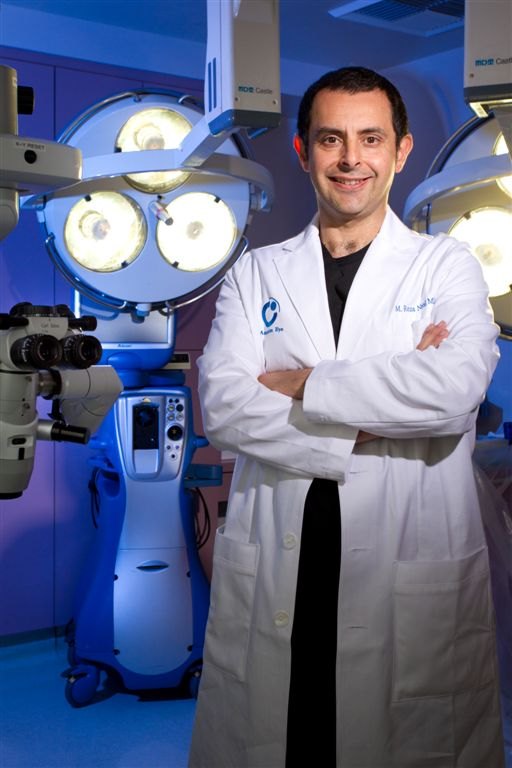
The first in the area to use laser cataract surgery.

Dr. M. Reza Neal was the first surgeon in the area to use advanced laser technology to improve the safety and accuracy of cataract surgery. He has performed more than 40,000 surgical procedures and has led Anaheim Eye Institute since 2005.
Ask every question you have. We’ll explain each step so you know exactly what to expect.

Cataract FAQs

Questions patients ask us.

When should I have cataract surgery?

Usually when cataracts start to interfere with daily activities like reading, driving or seeing at night. Your eye exam will help you decide on the timing.

Will I still need glasses?

It depends on the implant you choose. A standard monofocal lens usually means glasses for some tasks, while toric and multifocal lenses can reduce or eliminate that need.

What is ORA technology?

ORA (Optiwave Refractive Analysis) measures your eye during surgery to confirm the implant power. We use it on every lens procedure, and it’s especially helpful if you have astigmatism or had LASIK before.

What is a secondary membrane?

Sometimes the capsule that holds your new lens turns cloudy over time. A quick YAG laser treatment in our office clears it in a few minutes, with no trip to the surgery center.

How long does a lens implant last?

Implants are designed to last a lifetime.

Your best vision starts here.

Call us
Visit US
1211 W La Palma Ave, Ste 201
Anaheim, CA 9280
Office hours
Monday–Friday, 8 am–5 pm
Saturday–Sunday closed